

Swimming Lessons
Warm up

Five pools. Five decades. Five stories that shaped my life. I uncover the wisdom that rises when I allow the water to carry me.
A memoir
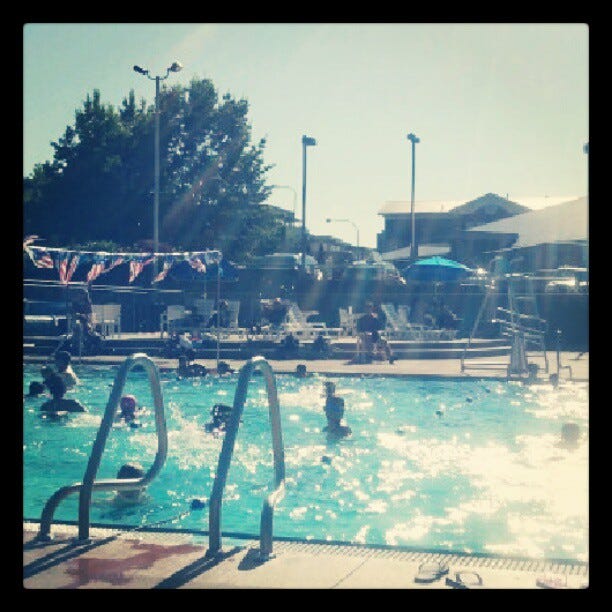
Water teaches with silence. It shows us how to soften, how to breathe, how to begin again.
Water has always been a teacher.
Before words, before doctrine, before the stories we tell ourselves about who we should become, there is the quiet instruction of immersion. Life begins in water, where we float without effort. Learning to swim is simply remembering how to be carried. And in the instant the world above goes muffled and the world within sharpens, something in us shifts. Swimming asks us to surrender the solidity of land and inhabit a different kind of knowing — one shaped by rhythm, breath, and buoyancy.
We enter the water, and it meets us in return. That exchange softens the edges of who we think we are. We forget our weight. We suspend. We move into a liminal place where motion slows into flow and thought dissolves into presence. It feels like stepping out of one life and into another, if only for a few strokes.
I have always been drawn to this transformation, even before I had language for it. As a child, slipping into a pool felt like entering a secret world — a muted underworld where imagination opened, and my body understood itself without instruction. As an adult, I returned to the water when life grew sharp or heavy or confusing, drawn back by something ancient, cellular, remembered. Each time, I found that swimming changed me. It still does.
Water holds its paradox: it is life and danger, comfort and fear, freedom and surrender. To swim is to live inside that tension with humility. On land, we cling to the illusion of certainty. In water, we learn to meet the unknown with curiosity. We learn to yield without collapsing. We learn that the body we have doubted, disciplined, or ignored is capable of holding us up.
Maybe that is why swimming teaches presence. Breath becomes a metronome that steadies the mind. Repetition becomes meditation. Stroke, breathe, glide, and the noise of the world loosens its grip. Swimming awakens a playfulness we often lose. It returns us to the joy of being held, buoyed, carried. It returns us, in some ways, to the womb, our first experience of water…our first experience of belonging.
I’ve swum in many pools across my life, but five have represented anchors or markers of the decades in which I was learning lessons I didn’t yet know I needed. At age six, swimming meant freedom. At sixteen, it became a proving ground. In my twenties, water held my grief after a miscarriage. In my thirties, I began again as a beginner, learning technique and confronting the idea of perfection. And in my forties, floating in a sunlit pool in Mexico, I felt myself return to the truest version of who I was.
Each pool reflected a version of me. Each asked something different. Each taught a lesson about the body, about voice, about faith, about worthiness.
Woven through all of them was a question I avoided for years, one that eventually rose like a breath held too long:
What does it mean to come home to yourself?
Over the next six weeks, on Mondays, I will share a newsletter in my attempt to answer that question…or at least to trace the path water carved through my life as I learned. It is an exploration of how a woman loses and finds trust in her own body. How faith breaks open and expands. How voice returns after silence. How play becomes wisdom. How water, in all its paradox, becomes a mirror we cannot ignore.
These essays are not about swimming technique or athleticism. They are about life beneath the surface — the inner tide that carries us. The kind that changes you. The kind that reminds you how to breathe again.
Welcome to Swimming Lessons.
Next week, we’ll begin where all transformation begins: at the water’s edge.
To read the rest of the series, click HERE
Thank you for reading. If you’d like to support this work, the best ways are to subscribe (free or paid), share the newsletter with someone who might enjoy it, leave a comment, or buy me a coffee. Your presence here means more than you know.
With love,
Dawn
This is one of those pieces that quietly disarms you. It starts sounding like nostalgia and ends up talking about consent, trust, grief, and coming back into the body without ever announcing itself as “wisdom.”
Also, points for reminding us that presence doesn’t always arrive through discipline or effort. Sometimes it shows up because you let the water do the work. That feels like a lesson a lot of very serious spiritual systems keep forgetting.
What a beautiful way to craft this narrative and invite reflection and conversation!