

Permission to Matter
A new book by Bekah Stewart!

I have the deep joy of introducing you to a book—and a woman—that I believe will stir something sacred within you.
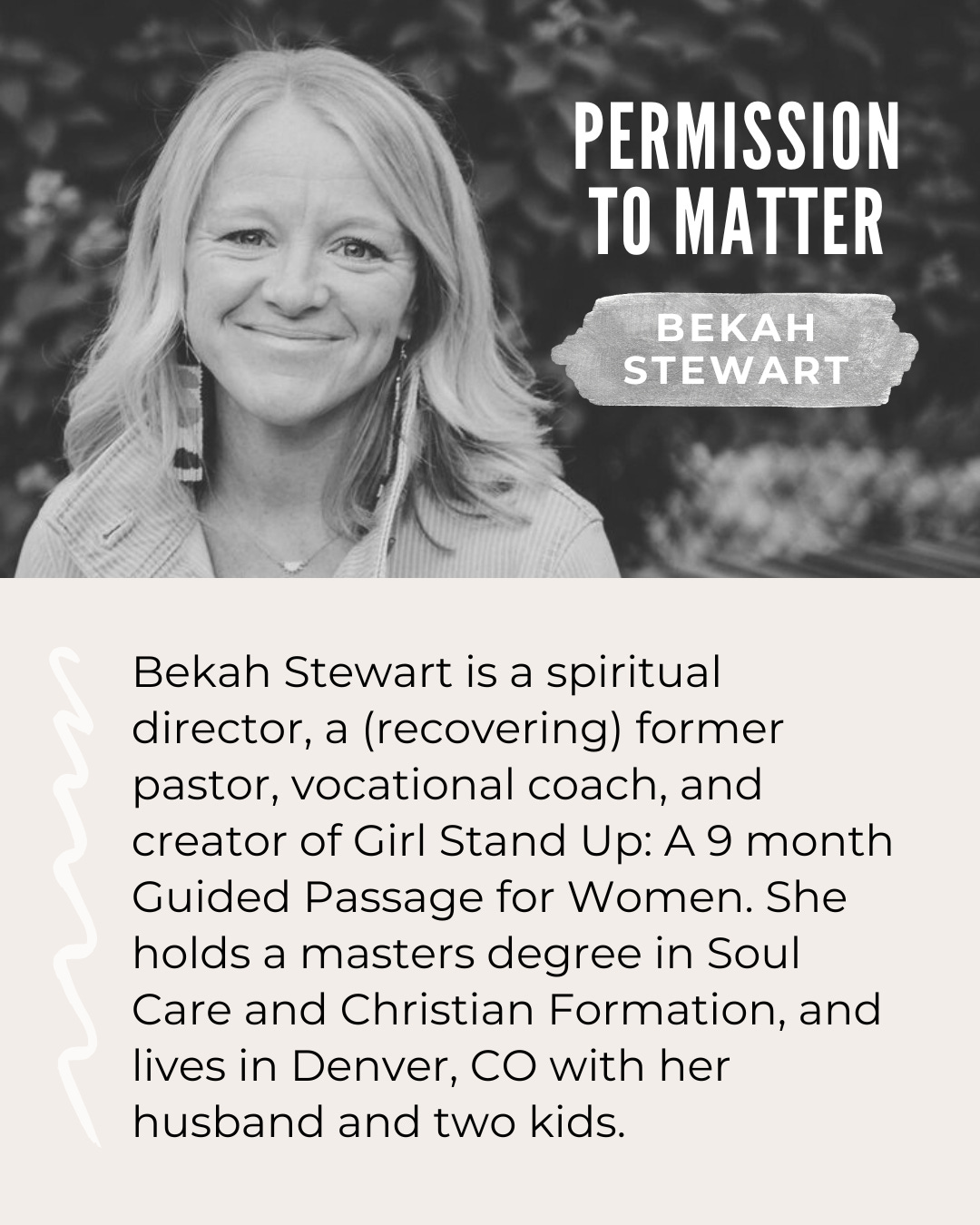
Today, I’m sharing my review of Permission to Matter by Bekah Stewart, a book that spoke directly to places in me that have longed for permission, affirmation, and a deeper knowing of God as She truly is. Reading it felt like both a homecoming and a commissioning. It is tender, wise, courageous work—and the kind of book I’ll return to again and again.
Even more special, I had the opportunity to interview Bekah and ask about the stories behind the book, the spiritual journey that shaped it, and what it means to reclaim our agency, voice, and God-given humanity as women of faith.
If you’ve ever found yourself wrestling with the role of women in the church, longing for a more expansive view of God, or aching to come out of hiding and live as your fullest self—this one is for you.
Let’s begin.
Permission to Matter: Reclaiming Women’s Humanity and Authority at the Invitation of Jesus by Bekah Stewart
My Book Review:
For every woman who has ever felt too much, not enough, or unsure whether her voice belongs in the sanctuary.
Reading Permission to Matter felt like being handed a map home—back to my body, my voice, and the God who’s always been for me. Bekah Stewart has written the kind of book I didn’t know I was waiting for: a wise, tender, deeply honest invitation to wake up from the sleepy scripts of patriarchy and return to the truth that we matter—fully, wholly, fiercely.
This book doesn’t waste words. Stewart moves through theology, personal story, and embodied reflection like a practiced guide. She writes with the clarity of a teacher and the compassion of a soul-friend, gently deconstructing the inherited lies many of us have breathed in for decades and pointing us toward the expansive, generous love of a God who made us very good.
I found myself nodding, underlining, and even tearing up as she named what so many women know deep in our bones but struggle to say aloud: that the Church often asks us to play small, deny our knowing, and outsource our permission. But here is a voice reclaiming permission—offering it back to us not as something we must earn, but as something that’s already been given by the God who dwells within us.
If you’ve ever wrestled with the tension between your faith and your feminism, if you’ve ever wondered where you fit in the grand story of God, or if you’re simply tired of shrinking in spaces that were never meant to hold your fullness—read this book. Read it slowly. Read it with a pen and a journal. Better yet, read it with a circle of women and see what Spirit does among you.
Bekah Stewart isn’t just giving us permission to matter—she’s lighting the way toward a fuller, freer, more beautiful gospel. One where women don’t just belong, but lead, speak, embody, and rise.
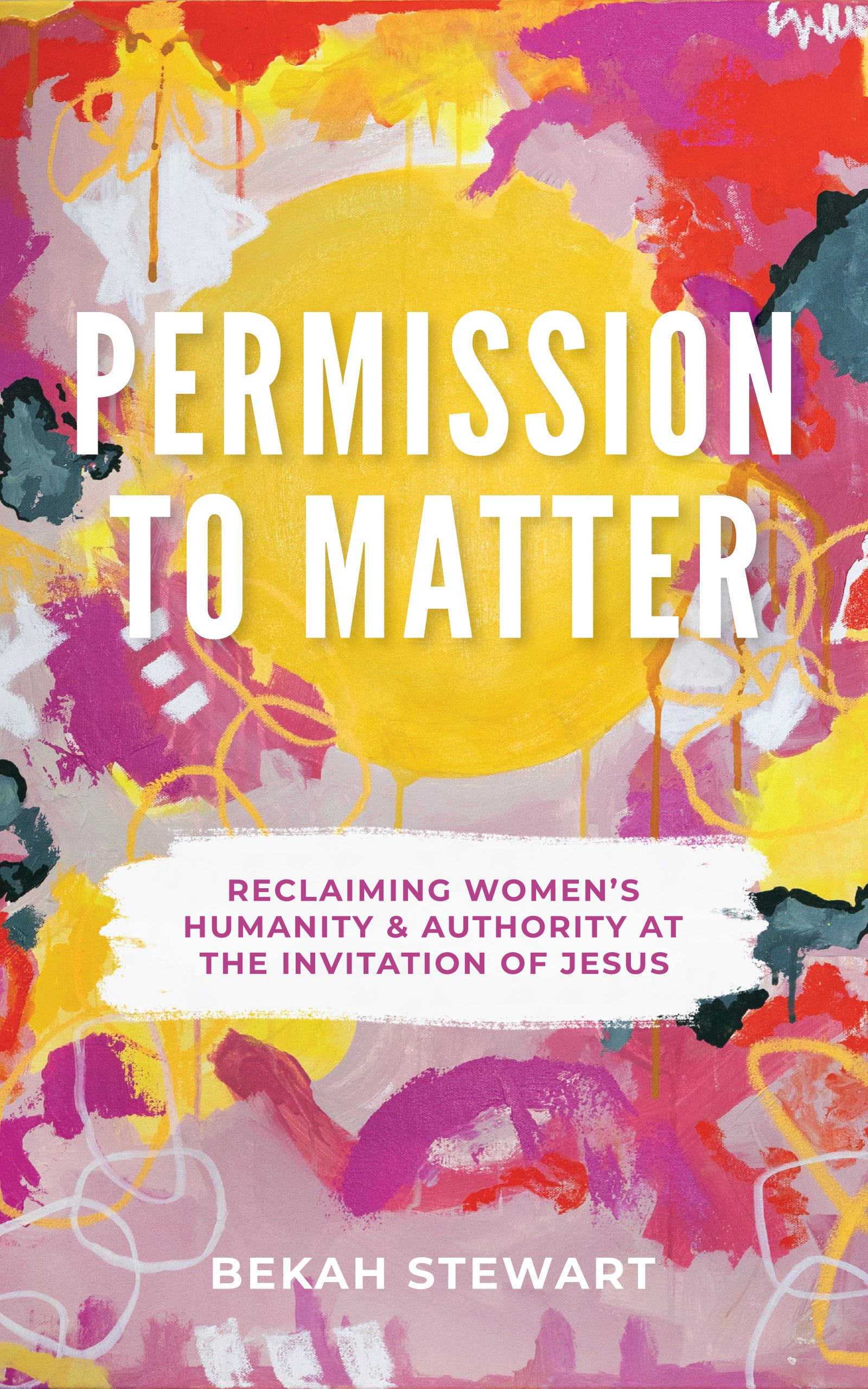
This book is available today, June 1st! You can find it HERE.
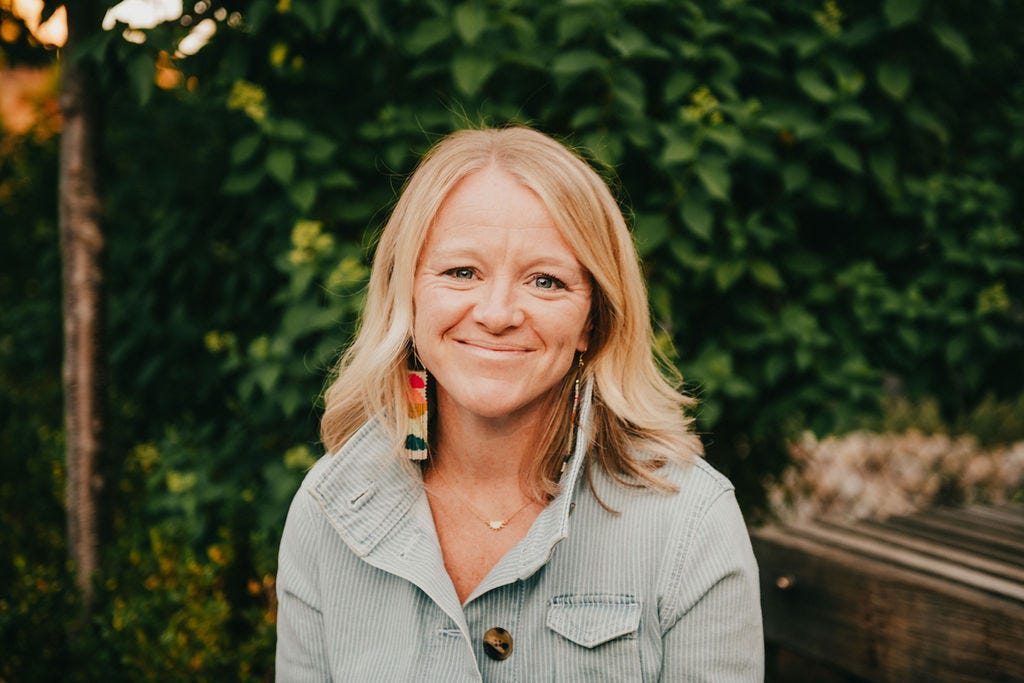
Interview with Bekah Stewart, author of Permission to Matter: Reclaiming Women’s Humanity and Authority at the Invitation of Jesus.
What personal experiences led you to write Permission to Matter, and how did they shape your understanding of God?
Permission to Matter is the outcome of my own wrestling with the female spiritual journey. I kept finding myself in environments (conservative and progressive) that communicated the need to, eventually, come face-to-face with my limits, surrender to a higher power, and take a journey of descent. I was encouraged to move toward “humility,” self-sacrifice, and a laying down of ego—sure signs of maturity. It all seemed to be working for me until my “waking moments” began. In the book I define these moments in a woman’s life as, “…little invitations to wake back up to our full humanity. It’s as if God whispers in our ears, ‘You matter more than you’ve been led to believe.’” They come in a million forms and surface a million emotions, but in my experience, mostly angst. I found myself questioning things I had never questioned. I began to notice the very subtle ways in which patriarchy had shaped almost every area of my life—especially church and my understanding of God. I became restless.
During this season I participated in a workshop where the leader made a passing comment referring to her “female awakening.” It wasn’t her main point but I couldn’t shake it. At the end of the time, I immediately made a beeline for her and asked for recommended resources. She suggested two books: The Dance of the Dissident Daughter by Sue Monk Kidd, and Caretakers of Our Common House by Carol Lakey Hess. Both turned out to be transformative, but in particular, Carol Lakey Hess’ work helped make sense of my angst.
According to Hess, the result of primarily male written and informed theology, is an over emphasis on male-specific sin. Hess would say that the primary sin a man in a patriarchal world must contend with is that of pride. He’s been told he ought to be more than he is--bigger than big. And so, the necessary spiritual journey would include confronting his limits, surrendering to a higher power and taking a journey of descent. So, should this automatically become the spiritual framework for all people across all time? Hess would say no. Women have a different sin to contend with: self-abnegation. Whereas men have been told to become big, women have been told to become small. A women’s primary sin is that of rejecting or renouncing the self.
In order for a woman to move into her full humanity—to become fully who God created her to be—her journey must include coming face-to-face not with her limits, but instead with the enormity of her potential that has been pushed underground and put to sleep. She must confess the god-like status she has given to patriarchy, and repent, which simply means to turn. Now she can head in the direction of her full humanity—a journey of ascent. Permission to Matter is an exploration of and invitation into this journey.
You write about how most spiritual frameworks were made by men, for men. What are some subtle ways this still shows up in the church today, especially in how women are taught to relate to God?
When a woman is told that she is made in the image of God, but then is only ever given male God-images, and male-centered and male-normed faith systems and structures, she (typically unconsciously) learns to accommodate. She mentally and emotionally works her way around what she is taught, finding ways to incorporate and find herself in it. In Permission to Matter I refer to this skill as “intellectual flexibility.” This isn’t necessarily a bad skill to have. I mean, imagine if all people—regardless of gender—had as much practice in the art of accommodation. But when this becomes a female specific skill—and really a necessity—it moves beyond just being a skill. It becomes the default posture. Women don’t just accommodate, they become an accommodation. Everyone’s expectations are then shaped around this: women should be polite, understated, not too big or too much, overly apologetic, etc. Ultimately, this reality works against the journey a woman must go on to move into her full humanity.
You center the gospel story of the Bleeding Woman and the Dying Girl as archetypes for the female spiritual journey. Why these stories, and what do they reveal about Jesus’ invitation to women?
I intersected these stories as archetypes in a very personal way. I was working my way through the Gospel of Mark and practicing Imaginative Prayer. It is no coincidence that at the time I was placing myself in the story of the Bleeding Woman, I happened to find myself in a season of irregular menstrual bleeding. Suddenly this powerful story became my story. My work on the female spiritual journey framework had already begun at this point. I was exploring the female path of descent, coming face-to-face with potentials, and then going on a journey of reclamation and ascent. As I spent time in Mark 5 with this woman (and the girl whose story is intertwined) I began to see how the invitation Jesus was offering them (and me) actually matched the framework I was exploring. In the story of the Dying Girl and Bleeding Woman we find an invitation from Jesus to Wake Up, stand Up, & Come out of Hiding.
What would you say to a woman who’s been wounded by church teachings and now finds it hard to trust God or her own inner voice?
First of all, as a former pastor and minister for many years, I’m sorry. The mistrust you feel is actually a sign of your own inner knowing. You should feel mistrust toward a person or institution that has asked you to be less than who you actually are. It’s your body’s way of saying, “this isn’t exactly right.” It’s good and right to listen to this and to take the necessary steps to distance yourself from harm. You are made in the image of God, fully human, and very good. Your task is to reclaim your God-given authority and agency. My one word of caution: distance yourself from harm, but don’t give away God. The people and places who are teaching these things don’t own God. So, in your moving toward healing, be careful not to leave behind what is rightfully yours. Moving toward healing doesn’t have to mean leaving behind God.
If the Church fully embraced women as spiritual equals, what would change—and what new possibilities would open up for the body of Christ?
“When the sacred feminine can take root & bloom, everything that patriarchy has put aside blooms with it: inclusiveness, for example, in place of obsessive separations; laughter in place of solemnity. Painstakingly drawn lines of authority give way to creative partnerships, and everything that has been frozen thaws and flows and dances. Walls come down." -Carol Lee Flinders.
I’m not sure I can say it better than Carol. The world we are living in is offering us a daily (if not hourly) apologetic as to why we are in desperate need to value and integrate the feminine in all places and on all levels.
Thank you for joining me in this conversation—one that I believe is sacred, necessary, and long overdue. I hope Bekah’s words offered you what they offered me: language for what you’ve known deep down, courage to reclaim what’s always been yours, and a vision of God big enough to hold all of you.
If Permission to Matter resonates, I encourage you to not only read it but share it. Let it be the spark for the kinds of conversations that help us wake up, stand up, and come out of hiding.
You may find Bekah in the following places:
This newsletter occasionally contains Amazon affiliate links. If you click on and buy through one of these links, I receive a small percentage at no extra cost. Thank you.
Quick Links:
May the peace of the Lord Christ go with you wherever he may send you; may he guide you through the wilderness; protect you through the storm; may he bring you home rejoicing at the wonders he has shown you; may he bring you home rejoicing: once again into our doors.
This feels like holy ground.
So many of us were taught to shrink in the name of obedience, to distrust our own knowing and call it humility. But Permission to Matter flips that script with grace and fire. Bekah’s voice doesn’t just comfort, it commissions. She names the ache so many of us couldn’t, and then lights a path toward something deeper, truer, freer.
I didn’t just feel seen while reading. I felt summoned.
Thank you for sharing this sacred work. The Church may have muted the feminine, but she is rising now with her voice intact.
Virgin Monk Boy 🕊️🔥
Bekah is a spark that is going to set fire to the church, in the best possible way!